Author: Dennis

Why success still feels empty for high performers and how a simple spiritual practice creates the stillness, clarity, and meaning achievement can’t deliver.

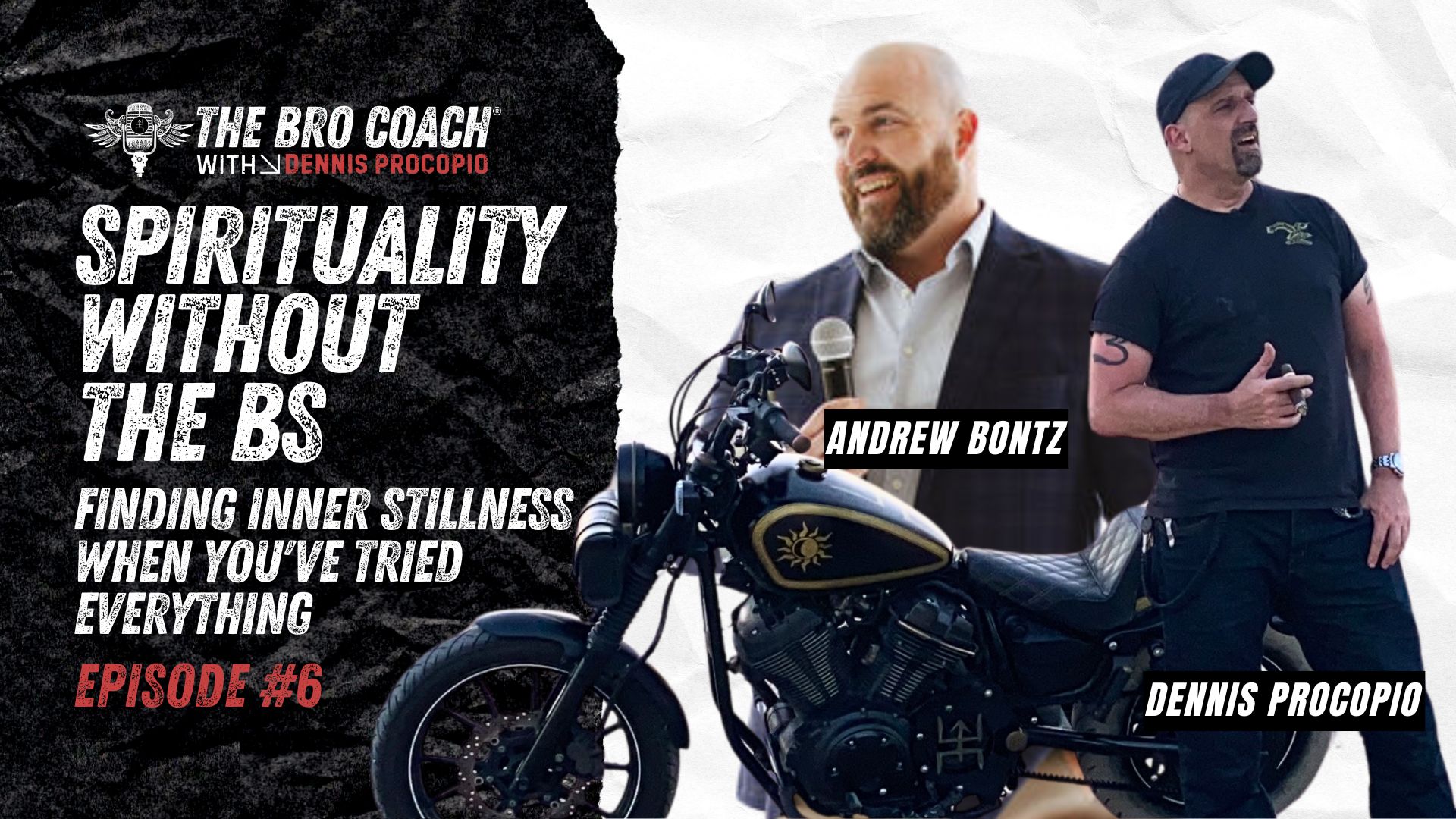
Spirituality Without the BS: Finding Inner Stillness When You’ve Tried Everything | Season 1, Ep. 6


SUMMARY

You’ve tried therapy. Self-help books. Podcasts. Courses. Gratitude journals. Ice baths. You’ve optimized everything—except the one thing that actually matters. Most high-achieving men chase the next win, believing more will fill the void.

But here’s the truth: You’re a spirit having a human experience, not a human trying to have a spiritual experience. And until you understand that, nothing will feel like enough.

In this episode, Dennis Procopio (The Bro Coach®) and Andrew Bontz cut through the BS about spirituality, meditation, and what actually works when success leaves you feeling empty.

Key Topics

  • Why success without a spiritual practice is just noise
  • The critical difference between religion and spirituality (and why you don’t need a label)
  • How to move from “me first” to “we first” without losing your masculine edge
  • Why meditation terrifies high-performers—and why that’s exactly why you need it
  • Dennis’s journey through Judaism, Catholicism, Buddhism, Hinduism, and what he discovered
  • The uncomfortable truth about stillness and why you can’t sit alone with your thoughts The daily practice that reveals what achievement never will

Resources

The #1 Confidence Mistake Men Make (And How to Fix It)

Look man, most guys think confidence is something they either have or they fake. They treat it like a vibe, an energy, some kind of swagger they’re supposed to summon on command.

Here is the truth.

The number one confidence mistake men make is confusing performance with preparation.

They want to feel powerful in the moment, but they skip the boring, unsexy groundwork that makes confidence automatic. They want to walk into a meeting, a conversation, or a challenge and just magically switch on the alpha version of themselves.

But confidence does not come from moments.

It comes from preparation.

It comes from proof.

So let’s break down a fresh framework, built on real-world male psychology, performance coaching, and the training principles you already understand. This time, through a new lens.

Step 1: Build “Evidence Reps,” Not Hype Reps

Most men try to talk themselves into confidence. They repeat affirmations. They listen to pump-up speeches. They try to fix their mindset with words.

But confidence is not built by talk. It is built by evidence.

Evidence that you can do what you say you will do. Evidence that you keep your own promises. Evidence that your behavior aligns with your values.

Every time you follow through, you notch an “evidence rep.”

That rep becomes data. And your nervous system believes data, not hype.

Confidence is the quiet that comes from proof, not the noise that comes from hype.

So forget trying to feel confident. Start building evidence you can trust.

Step 2: Stop Relying on Big Moments, Start Winning Invisible Ones

Men want the breakthrough. The shot-caller moment. The dramatic win. But in performance coaching, the breakthroughs only land for the men who are already dialed in on the invisible fundamentals.

It is the tiny, private actions that build the capacity you draw from later.

Invisible wins look like:

  • Getting up when you said you would
  • Finishing the last rep when nobody is watching
  • Making the uncomfortable phone call instead of shelving it
  • Choosing discipline once when quitting is easier

Those are the reps that build internal authority.

Think of it like basketball. The confidence to take the clutch shot was built long before game night, in empty gyms, during boring drills, when nobody was cheering.

High confidence men are not bold because of the moment. They are bold because their fundamentals are airtight.

Step 3: Create a Confidence Baseline You Can Always Fall Back On

Strength athletes talk about “baseline strength,” meaning the minimum level they can perform even on a bad day. Most men have no confidence baseline, which is why they collapse the moment life applies pressure.

A baseline is made of three parts:

  1. A ritual that grounds you
  2. A skill you have mastered
  3. A standard you refuse to negotiate

When life hits, you default to your baseline. If that baseline is tight, you stay steady. If that baseline is weak, you get rattled.

Your job is to hardwire a baseline that keeps you stable when everything around you is unstable.

This is not emotional bravado. This is operational readiness.

Step 4: Treat Challenges Like Sparring, Not Combat

Here is a new metaphor to break the mold. Most men treat every challenge like a high-stakes fight. The mindset is “I can’t screw this up.”

No wonder their confidence cracks. They walk into everyday situations with championship pressure.

Try this instead:

Treat challenges like sparring rounds.

In sparring:

  • You learn
  • You absorb feedback
  • You get tagged
  • You get better

There is no shame in taking a hit because the purpose is growth, not domination.

When men shift from “I must win” to “I’m here to learn,” confidence skyrockets because the cost of failure drops. Fear disappears when the downside is education, not embarrassment.

This single mindset shift has helped more high performers at MULC than any motivational tactic ever will.

Step 5: Build a Confidence Ecosystem That Sustains You

Here is something unique we have not covered anywhere else.
Confidence is not built in isolation. It is built inside an ecosystem.

Your environment either reinforces your identity or undermines it.

An elite athlete has:

  • A coach
  • A training plan
  • A team
  • A feedback loop
  • A mission

Men who try to build confidence alone are missing four out of five of these.

You need people who challenge you, structure that focuses you, and accountability that keeps you honest. Alone, you will overthink. In a system, you will grow.

You can force progress alone. You can only sustain it in a system.

This is why coaching accelerates everything. Not because you are weak, but because every strong man has a structure behind him.

Confidence Checklist: The Prep That Makes You Unshakable

Use this daily. It is different from previous checklists.

  • One evidence rep completed
  • One invisible win executed
  • One baseline ritual honored
  • One sparring opportunity accepted
  • One accountability connection made

These are not motivational hacks. They are operational protocols. Keep them tight and your confidence becomes inevitable.

The Recap You Need

Confidence is not a mood. It is not style. It is not swagger.
It is preparation.

The number one mistake men make is trying to perform confident instead of preparing confident.

Fix that, and everything changes.

When you build evidence, stack invisible wins, establish a baseline, spar your way into resilience, and surround yourself with the right ecosystem, you stop chasing confidence and start living it.

This is the work.

This is what strong men train.

And if you want a system that accelerates all of this ten times faster, that is exactly what coaching is for.

The Difference Between Solving Problems and Talking About Them

Look man, here is the truth most guys never hear. There is a huge gap between processing your problems and actually solving them. One keeps you aware but stuck. The other gets you moving again.

A lot of men never bridge that gap. They talk, vent, analyze, break down their childhoods, map out their blind spots, and dig through every emotional file folder in their brain. Useful, sure, but only if it leads somewhere.

But for most men, it doesn’t.

This article breaks down the difference between two very different paths: therapy, which is built around understanding, and coaching, which is built around action. One is reflective. The other is forward-focused. One helps you process. The other helps you perform. And if you are a high-performance man who wants to win in the real world, knowing the difference is everything.

Coaching vs. Therapy at a Glance

Coaching

Coaching is training. It is reps, accountability, strategy, and execution. It feels a lot like having a corner man in a fight who reminds you of the game plan and kicks your ass back into the ring when you hesitate. Coaching is for men who want momentum, clarity, and measurable progress.

Therapy

Therapy is processing. You slow down, look back, and untangle what happened. It is a long-form conversation designed to help you understand the roots of your patterns and emotional triggers. Powerful work, but often slow, reflective, and introspective.

Both have value. They are just built for different missions.

The 5 Key Differences: Solving vs. Talking

Comparison Table

CategoryCoachingTherapy
FocusFuture, action, execution3–Past, patterns, processing
EnergyHigh intensity, performance mindsetSlower, reflective, emotional exploration
GoalsResults, clarity, behavior changeHealing, understanding, emotional resolution
MethodStrategy, accountability, feStrategy, accountability, feedback loopsAnalysis, emotional insight, narrative exploration
SpeedFast, structured, outcome-drivenGradual, exploratory, insight-driven

Difference 1: Action vs. Awareness

Talking creates awareness. Action creates change.

Look man, most men already know what their problems are. They just don’t know what to do next. Coaching focuses on the next move. The next call. The next conversation. The next rep. It is a battlefield mindset, not a therapy couch mindset.

Awareness is the foundation. Action is the building.

Difference 2: Warrior Energy vs. Processing Energy

Therapy helps you sit with your feelings. Coaching helps you stand up and move with them.

In therapy, the energy is slower and softer so you can unpack your emotional history without pressure. In coaching, the energy is sharper and more tactical. You are not exploring your patterns, you are breaking them. You are not revisiting the battlefield, you are training for the next one.

Both energies matter, but they serve different missions.

Difference 3: Performance Goals vs. Emotional Goals

Therapy asks, “Why?” Coaching asks, “What now?”

Therapy helps you resolve the emotional stories you have been carrying. Coaching helps you build the next chapter. Therapy helps you heal the wound. Coaching helps you strengthen the muscle.

If you want to perform better in relationships, business, health, or leadership, coaching is built for that runway.

Difference 4: Accountability vs. Exploration

In therapy, you explore what has been holding you back. In coaching, someone holds your feet to the fire.

Accountability is the ingredient most smart, high-achieving men do not realize they have been missing. You know what to do, but you do not do it consistently. Coaching creates friction, pressure, and follow-through. There is no hiding.

You can talk all day about why you avoid conflict. Coaching makes you pick up the phone.

Difference 5: Acceleration vs. Insight

Talking gives you insight.

Coaching gives you acceleration.

Insight without action becomes intellectual entertainment.

Guys can spend years in therapy understanding their triggers but never actually changing their lives. Coaching flips that script by turning insight into motion.

That is why high performers lean toward coaching. Not because they do not value therapy, but because they want speed, leverage, and ROI on their effort.

Which One Do You Need?

If you are drowning in unresolved trauma, deep grief, or emotional disorder, therapy is a critical and necessary path. It is the right tool for the job.

But if you are a high-functioning man who knows you could be doing more, earning more, loving more, leading more, and living more, then you do not need more conversations. You need a coach. You need direction, structure, pressure, and performance training.

You need someone who refuses to let you stay stuck.

You need someone who challenges you to Man-Up, not through force, but through self-mastery.

Your Time, Sanity, and Potential Are on the Line: Is Coaching Worth It?

Look man, here’s the uncomfortable truth you already feel in your gut: You can be smart, disciplined, and motivated, and still be stuck.

Not because you are weak, but because you are trying to outwork problems that require strategy, not strain.

Trying to fix your life alone is the modern equivalent of trying to rebuild a jet engine while the plane is still in the air. You can be damn good at improvising, but eventually gravity catches up. And when it does, it hits your time, your mental bandwidth, your money, and the opportunities you didn’t even realize you were losing.

This is the real cost of “figuring it out alone”.

This is why coaching exists..

The Problem: You Are Bleeding Time, Energy, and Potential

High performing men rarely hit rock bottom. Their problem is worse.
They coast at 60 to 70 percent of their potential while telling themselves they are at 90.

Here’s what it actually costs:

Time Lost to Trial and Error

Without structure, every decision becomes a maze. You spin your wheels, revisit the same problems, and lose weeks or months to circular thinking.

Stat Snapshot:

Most men waste between 6 and 12 hours every week to indecision. That adds up to hundreds of hours a year.

Money Lost to Hidden Inefficiency

Overworking instead of delegating.
Burnout that kills productivity.
Emotional stress that sabotages your judgment.
Unresolved conflict at home that bleeds into your performance.

The silent tax on your life is not coaching, it is indecision.

Energy Lost to Mental Load

Decision fatigue drains you before your day even begins. Waking up tired is not age, it is cognitive overload from carrying everything alone.

Momentum Lost to Isolation

Even the strongest men miss their blind spots.
You cannot read the label from inside the bottle, and you cannot coach yourself while drowning in your own thoughts

Opportunities Lost to Slow Decisions

When you hesitate, someone else moves.
A conversation you avoided, a decision you delayed, a pattern you refused to break.
Every delay has a price.

The Real Wake-Up Call

If you are brutally honest, you know this:

Your problem is not lack of effort.
Your problem is inefficient effort.

You keep trying to upgrade your results without upgrading the system driving them. That never works. Not in business, not in fitness, not in relationships.

Trying harder is not the same as getting better.

The Solution: Coaching Is ROI, Not a Luxury

Coaching is not about fixing you, it is about optimizing you.

It is the same reason athletes have trainers and CEOs have advisors. Not because they are incapable, but because they want to win.

Clarity on Demand

You stop guessing and start executing.
Clear goals, clear priorities, clear action steps.

External Accountability

Left alone, even disciplined men drift.
A coach holds your standards where they belong.

Faster Decision Making

Weeks of thinking collapse into minutes of clarity

Emotional Mastery

Pressure stops being a trigger and becomes fuel.

Leverage

This is the multiplier.
Your actions stop leaking energy into nonsense and start compounding.


Proof That Coaching Works

Across the coaching industry, results consistently show:

• Most clients report improved performance
• Most report higher confidence
• A majority recoup their investment within a year
• Nearly all say they would hire a coach again

At Man-UP Life Coaching, results hit harder because the system is built specifically for men, their psychology, their pressure, and their lifestyle.

What Men Say When They Finally Get Help

Real outcomes from real high performers:

• “I got more done in two months with coaching than in two years on my own.”
• “I stopped blowing up my relationship and started leading again.”
• “It felt like someone finally handed me the manual to my own mind.”

These are not exceptions. They are the norm.

The ROI Formula for Coaching

Here is how to know if coaching is worth it:
Cost of Inaction > Cost of Coaching

That is the entire equation.
If staying where you are is more expensive, painful, or limiting than the investment required to level up, then the decision is already made.

Most men wait until something breaks.
High performing men act before it does.

Final Word

Your time, sanity, and potential are not replaceable.
You only get one life, and it is moving faster than you think.

If you already know you are capable of more, coaching is not a luxury. It is the smartest investment you can make.

The real question is not, “Is coaching worth it?”
The real question is, “What is it costing you not to do it?”

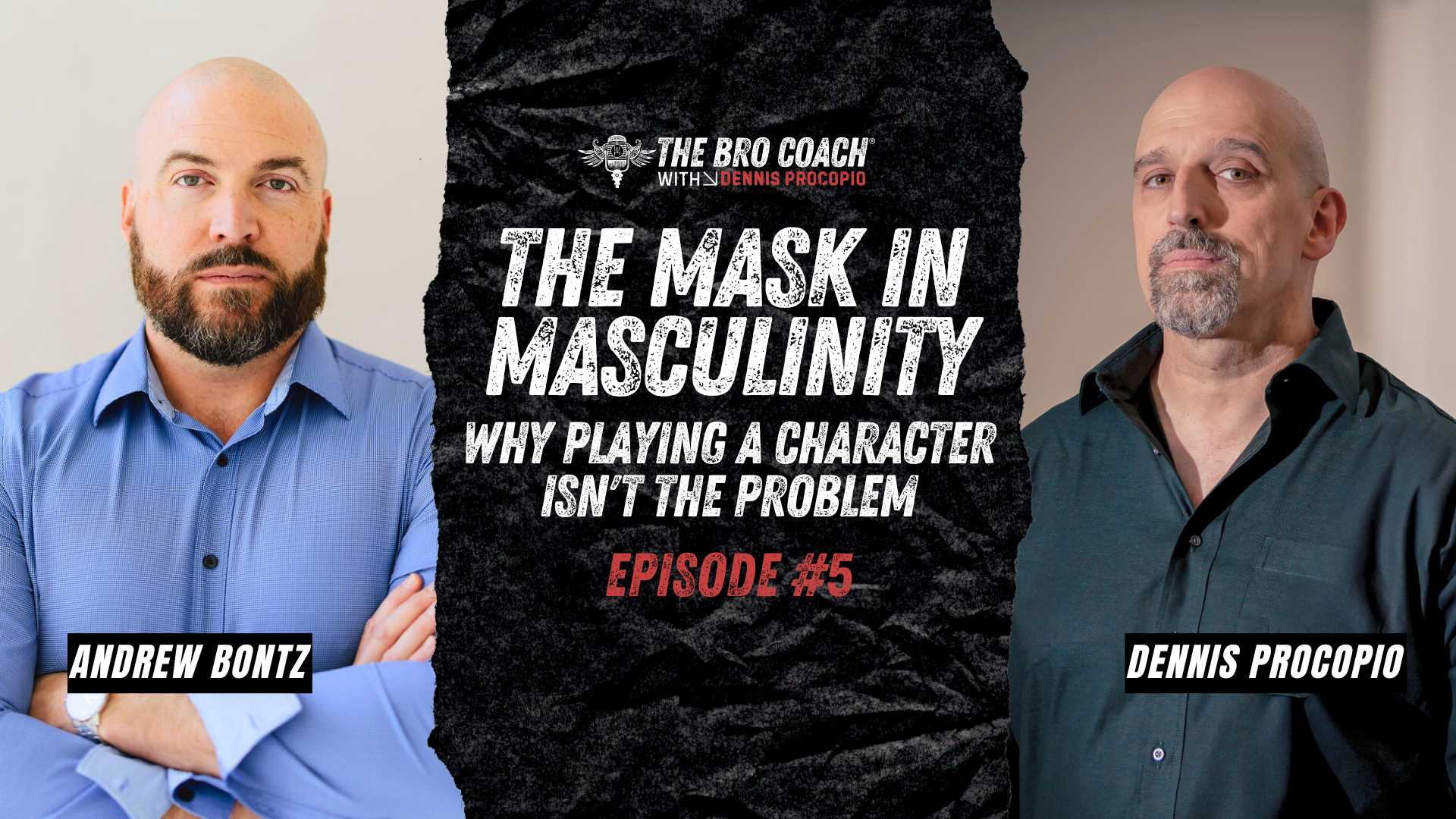
Most men spend their lives asking "what's appropriate?" instead of "what's authentic?" Dennis Procopio (The Bro Coach®) sits down with Andrew Bontz, COO of Man-UP! Life Coaching, for a raw conversation about authenticity, fear, and why every man wears masks—and why that's not actually the problem.

The Mask in Masculinity: Why Playing a Character Isn’t the Problem | Season 1, Ep. 5


SUMMARY

You follow the rules. You’ve learned what’s appropriate. You show up as the guy everyone expects you to be. So why does it feel like you’re hiding? Why can’t you just be yourself without worrying what people think? And why does the thought of being vulnerable make you want to run in the opposite direction?

Most men spend their lives asking “what’s appropriate?” instead of “what’s authentic?” You’ve learned to be a chameleon—adjusting your personality for the boardroom, the bedroom, your buddies, your family. You’ve mastered the art of social approval. But here’s the brutal truth: The mask you’re wearing has less to do with convincing people you’re something you’re not, and more to do with hiding who you’re afraid you really are.

In this episode, Dennis Procopio (The Bro Coach®) sits down with Andrew Bontz, COO of Man-UP! Life Coaching, for a raw conversation about authenticity, fear, and why every man wears masks—and why that’s not actually the problem.

Key Topics

  • Why men hide behind masks—and it’s not what you think (it’s about fear, not performance)
  • The “nice guy mask” and why seeking social approval keeps you stuck in character
  • Dennis’s story of going to 24 schools and becoming a master chameleon (and what it cost him)
  • Why creative men are terrified of improvisation—and how that fear bleeds into everything
  • Andrew’s salsa dancing breakthrough: from sitting on the sidelines to getting on the floor (and what made him finally do it)
  • The critical difference between playing a character and being so committed you forget what you really are
  • Why masks aren’t the enemy—taking them too seriously is
  • The code that keeps you grounded: love, service, and brotherhood (the glue that matters)
  • How to recognize you’re wearing a mask without making it your entire identity

Resources

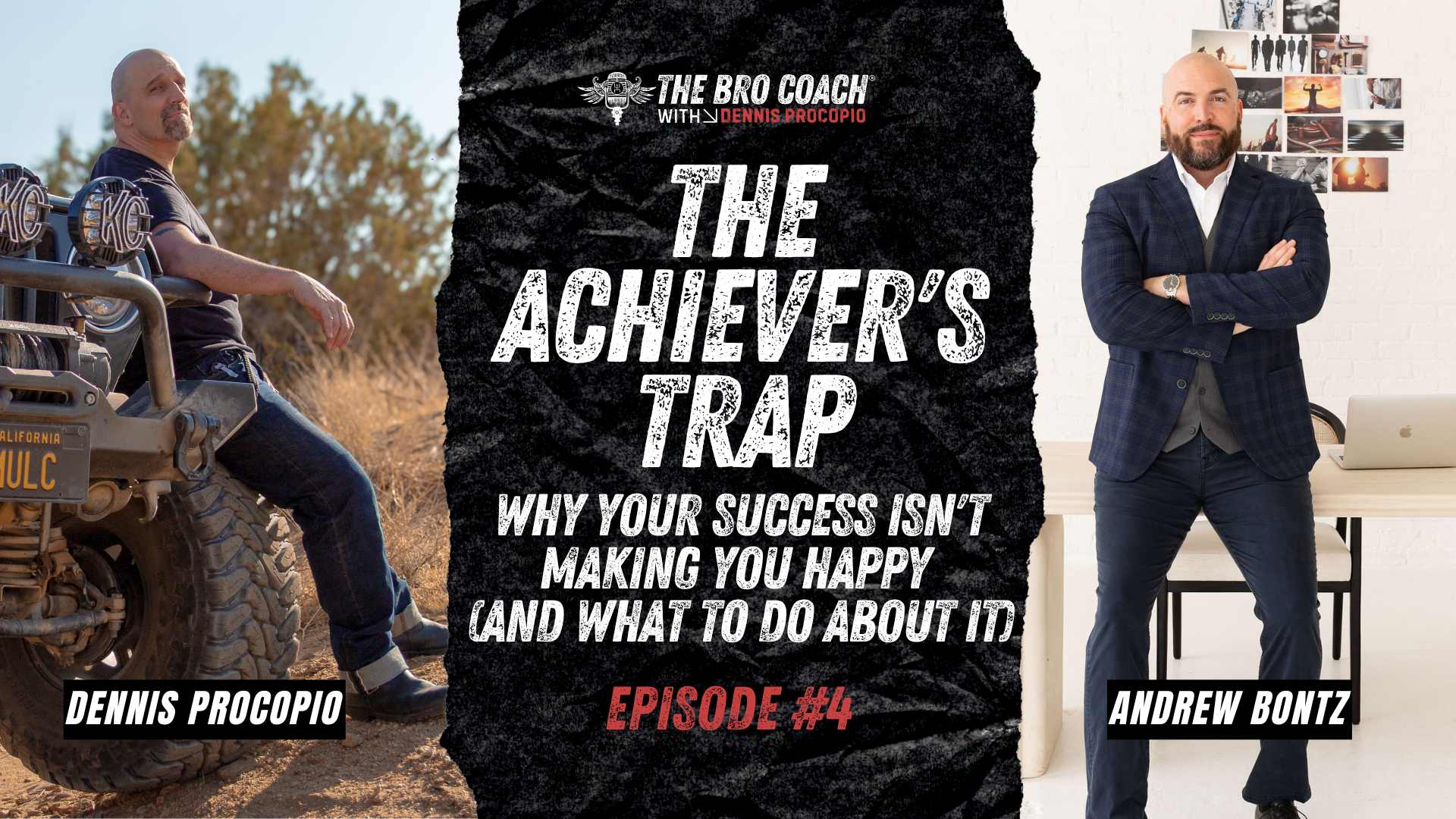
The Achiever’s Trap: Why Your Success Isn’t Making You Happy (And What to Do About It) | Season 1, Ep. 4


SUMMARY

Why successful men are still unhappy: The difference between self-worth and self-esteem explained. Most high-achievers are optimizing the wrong metric. You’re chasing external validation (self-esteem) when what you actually need is internal self-worth. Dennis Procopio breaks down why your wins aren’t making you happy and the daily practice that changes everything.

Dennis Procopio (The Bro Coach®) and Andrew Bontz dive deep into why high-performing men struggle with happiness despite achieving their goals. This isn’t about toxic positivity or red pill ideology—it’s about understanding the root of male achievement addiction and how to build real, lasting self-worth.

Key Topics

  • Self-worth vs self-esteem (and why you’re focused on the wrong one)
  • Competency addiction: Why winners can’t stop winning
  • The generational programming keeping you stuck
  • How to father your inner child with unconditional love
  • The “make your line longer” parable that changes everything
  • Why service to others unlocks self-love

Resources

Why DIY Success Doesn’t Work (And What It’s Costing You)

The Problem with Going It Alone

Look man, you’ve built a life through grind and grit. You’ve been the problem-solver, the fixer, the guy who doesn’t wait for help. That mindset got you this far—but now it’s the very thing holding you back.

Every hour spent “figuring it out” is an hour lost to analysis paralysis. You’re solving problems that don’t need solving and reinventing systems that already work. You’re paying for it in ways you don’t even notice—time, stress, wasted opportunity, and a slow erosion of drive.

Real talk: independence is powerful, but isolation is expensive.

The Hidden Costs of DIY Success

You think you’re saving money by doing it yourself, but what you’re actually burning is time and energy—the two things you can’t replace.

MetricDIY PathCoached Path
Time to Breakthrough18–36 months of trial and error3–6 months with guided focus
Energy Efficiency60% wasted on reactivity90% focused on execution
Decision ClarityEmotionally biased, inconsistentData-backed, outcome-driven
Stress LevelsChronic and unmanagedReduced through structure and systems
ROI on Growth1.2× return (slow progress)3–5× return within first year

Source: International Coaching Federation (ICF) – 86% of clients report a positive ROI from coaching, and 70% see measurable performance improvements.

That’s not motivational fluff. It’s math. Coaching works because it compresses time, clarifies focus, and multiplies your results.

Why Smart Men Still Fall for the DIY Trap

High-performing men are wired to solve problems. That same instinct becomes a trap when applied to personal growth. You’re used to leading, not being led. But without external perspective, you end up trapped in your own feedback loop—smart enough to see the issue, but too close to fix it.

Books, podcasts, YouTube—they all give you information. But information without implementation just feeds overthinking. Coaching gives you structure, direction, and accountability. It turns “knowing” into doing.

Coaching: The Smartest Investment You’ll Ever Make

Let’s call it what it is—coaching is a performance multiplier.

  • Time: Accelerates progress by removing wasted effort.
  • Money: Converts clarity into higher income and better decisions.
  • Energy: Channels focus where it matters most.
  • Stress: Replaced with systems and predictability.
  • Confidence: Built through consistent execution, not empty hype.

Executives, athletes, and entrepreneurs all use coaching because it delivers one thing no DIY system can—results with accountability.

The ROI of Coaching in Real Numbers

According to global coaching studies, professionals who work with certified coaches report:

  • Improved performance (70%)
  • Better communication skills (72%)
  • Increased self-confidence (80%)
  • Enhanced work-life balance (67%)

Now imagine those same percentages applied to your business, your leadership, your marriage.
That’s the compounding effect of coaching—it pays dividends across every part of your life.

The Bottom Line: You Don’t Need More Effort. You Need Leverage.

Doing it alone feels strong, but it’s actually strategic weakness. You’re burning fuel without direction, mistaking motion for progress.

Here’s the thing: the smartest men don’t grind harder—they invest smarter.
They buy back time, focus, and results by getting the right support in their corner.

If you’re ready to stop guessing and start winning, it’s time to test your own ROI.

→ Run the ROI Calculator or Book a Trial Coaching Session.
No fluff. No therapy talk. Just results that pay for themselves.

Do You Need a Coach or a Therapist Here’s How to Know

Do You Need a Coach or a Therapist? Here’s How to Know

1. The Confusion Most Men Face

Look man, when life hits hard, you start asking the big questions: Do I need to talk to someone? But who?
Every high-performing man eventually faces that crossroad—between a therapist who helps you process, and a coach who helps you progress.

The truth? Both can change your life—but only if you pick the one that fits your current battlefield.

2. The Coach: Trainer for the Mind and Mission

A coach is like a performance trainer. He’s not there to diagnose your past—he’s there to condition your mindset for the next round.

  • Coaches work with men who are functioning but frustrated.
  • They focus on strategy, structure, and accountability.
  • Coaching is about execution, not excavation.

Think of it like this: if your life is a game, the coach is the one calling plays, not analyzing your childhood.

3. The Therapist: The Healer and Historian

A therapist is the emotional medic. Their mission is healing, not hustling.

  • Therapists work with men who are hurting or haunted by unresolved issues.
  • They help you unpack trauma, regulate emotions, and restore balance.
  • Therapy focuses on understanding patterns, not building performance.

If the coach trains your muscles, the therapist repairs your injuries. Both matter—but not at the same time

4. 5-Point Comparison: Coaching vs. Therapy for Men

CategoryCoachingTherapy
FocusFuture goals and performancePast wounds and emotional healing
MethodAction, accountability, measurable outcomesReflection, emotional insight, diagnosis
EnergyForward, tactical, disciplinedReflective, patient, nurturing
Ideal ForHigh-functioning men seeking clarity and resultsMen dealing with trauma, depression, or chronic anxiety
End GoalPersonal mastery and transformationEmotional stability and recovery

5. The Overlap (and the Line You Shouldn’t Cross)

Here’s the thing: both paths demand courage. But they serve different seasons.
If you’re struggling to get out of bed, therapy comes first.
If you’re ready to stop repeating patterns and start performing at your potential, coaching is your next move.

A great coach will know when to refer you to a therapist. A great therapist will know when to send you to a coach. That’s respect, not rivalry.

6. The Man-UP! Perspective

At Man-UP! Life Coaching, we don’t fix broken men—we train capable men to upgrade their operating system.
You’re not here to “cope.” You’re here to conquer.

Therapy helps you understand why you’ve been stuck. Coaching helps you decide what to do about it.

7. Final Recommendation: Pick Your Battlefield

Ask yourself:

  • Am I still bleeding from old wounds? → Therapy.
  • Am I healed but stuck in indecision? → Coaching.
  • Do I need clarity, structure, and accountability? → Man-UP! Coaching.

Real talk: your future depends on knowing which game you’re in—and playing it like you mean it.

Stat Snapshot:

  • 62% of men report improved confidence and clarity after 6 months of coaching.
  • Only 18% of men who consider therapy ever begin it—mostly due to confusion about what it’s for.
  • Combining therapy and coaching (in sequence) accelerates growth by up to 40%.

Key Takeaways

  • Coaching = performance, therapy = healing.
  • Both matter—but not at the same time.
  • Know your mission before you choose your mentor.
  • You can’t build a stronger man until you stop repairing the old one.
Coaching for Confidence: Why It Works When Books and YouTube Don’t

Coaching for Confidence: Why It Works When Books and YouTube Don’t

The Myth of “Learning” Confidence

Look man, you can’t think your way into confidence. You can’t binge podcasts, highlight self-help books, or follow alpha-male influencers and expect to wake up fearless. That’s not how human wiring works.

Confidence is a skillset, not a philosophy. And like any skill—boxing, leadership, sales—it’s built through repetition, coaching, and resistance. Without those three, you’re just collecting theory.

Why Books and YouTube Fall Short

Books give you insight. Videos give you hype. But neither gives you feedback.
Information doesn’t correct posture. It doesn’t call out hesitation. It doesn’t challenge your bullshit in real time.

You don’t need more information. You need immersion—someone who can see your blind spots, push your limits, and hold you to a higher standard than you hold yourself. That’s what coaching does.

Step 1: Define Your “Why” Like an Athlete

Every athlete trains for a reason—to win, to survive, to dominate. Confidence works the same way.
When men say they “want confidence,” they usually mean freedom from self-doubt. But that’s too vague. Coaching helps you pinpoint your specific arena—career, relationships, fatherhood—and build confidence for that game.

“If you don’t know your why, your will won’t last.”

In coaching, your why becomes your north star. Once it’s clear, discipline follows naturally.

Step 2: Train Through Controlled Resistance

Confidence grows under resistance, not comfort.
Your coach’s job is to apply strategic pressure—socially, mentally, emotionally—so you adapt. Just like a weight trainer increases load to stimulate growth.

In MULC coaching, that looks like:

  • Calling out avoidance patterns
  • Assigning high-stakes challenges
  • Tracking follow-through weekly

Resistance builds resilience. Every rep under pressure adds another layer of self-trust.

Step 3: Build Feedback Loops, Not Echo Chambers

You can’t measure progress without mirrors. A coach functions as a real-time feedback system—someone who spots patterns you can’t see.

Books can’t do that. YouTube comments sure as hell won’t.

Your coach helps you interpret your results objectively: what worked, what didn’t, and what’s next. That’s how confidence compounds—through measurable, guided iteration.

Step 4: Rewire Your Internal Dialogue

Here’s the thing—confidence isn’t loud. It’s quiet certainty built from repetition and reframing.
Coaching rewires the way you talk to yourself. You learn to swap “I hope I can” for “I’ve done the work.”

Practical coaching drills might include:

  • Reframing failure as feedback
  • Using pre-performance rituals
  • Creating “evidence lists” of wins

Each rep trains your nervous system to interpret challenge as normal, not threatening.

Step 5: Sustain It Through Brotherhood and Accountability

Even pros need teammates. That’s why high-performance men thrive in coaching cultures—where accountability isn’t punishment, it’s proof of commitment.

Man-UP! Coaching integrates male mentorship and team dynamic, helping men build confidence with other men, not in isolation. Iron sharpens iron.

“You can’t do pushups for someone else—but you can push together.”

Confidence-Building Checklist

  • Define your specific “why”
  • Identify one high-pressure zone to train weekly
  • Log your actions and results
  • Replace negative self-talk with neutral observation
  • Schedule one coaching conversation this month

Inspirational Recap: Real Confidence Is Earned

Confidence isn’t mystical—it’s measurable. It’s built through effort, reflection, and guided correction.
When you train with a coach, you stop guessing and start growing. You stop consuming and start executing.

Books teach theory.
YouTube entertains.
Coaching transforms.

When you’re ready to stop reading about confidence and start living it—Man-UP.

Coaching as an Investment: How High Performers Think Differently

Coaching as an Investment: How High Performers Think Differently

The Hard Truth About “Figuring It Out Alone”

Look man, every high achiever hits that point where drive meets doubt. You’ve built the business, earned the respect, maybe even built a family worth protecting—but inside, you know there’s still another level.

The problem? Most guys stall out right there. They start thinking, “I should be able to figure this out myself.”
That’s pride talking. And pride’s expensive.

Because while you’re overanalyzing, time’s still ticking.
Opportunities are passing. Relationships are thinning.
And energy—the most valuable currency you have—is bleeding out through stress and indecision.

You don’t notice the cost until you’re already paying interest on wasted potential.

The Hidden Costs of Going Solo

Time: The average man wastes 3–5 years in cycles of trial-and-error before finally getting professional guidance. That’s not growth—it’s drift.

Money: You might think you’re saving cash by skipping coaching. But how much have indecision, missed deals, and burnout already cost you? For a six-figure earner, even a 10% performance drag equals $15,000–$30,000 a year—and that’s conservative.

Energy: Every unresolved problem drains bandwidth. The longer you wait, the more scattered your focus becomes.

Opportunity: You can’t spot your next move from inside your own blind spots. The greatest ROI of coaching isn’t just what you gain—it’s what you stop losing.

Why High Performers Think Differently

The difference between average men and high performers isn’t talent—it’s perspective.
Average guys see coaching as a cost.
High performers see it as leverage.

They understand the equation:

ROI = (Results – Investment) ÷ Investment

That’s why they pay for speed, precision, and accountability. They’d rather spend money learning what works than waste years guessing what doesn’t.

As one client put it:

“I spent a decade trying to outsmart my own burnout. Dennis fixed it in six months. That wasn’t therapy—it was tactical alignment.”

Proof That Coaching Pays

  • 73% of coached professionals report better relationships and team dynamics.
  • 86% of companies say they recouped their coaching investment, and many doubled it.
  • Performance ROI: On average, coaching yields a 5–7x return in measurable outcomes like productivity, leadership effectiveness, and decision-making clarity.

The data’s clear: coaching doesn’t cost—it compounds.

The Psychology of Investment

Every man invests somewhere—stocks, real estate, gear, vehicles.
But here’s the paradox: most men diversify everywhere except themselves.

The truth is, your mind and habits are the operating system for everything else.
You wouldn’t run a million-dollar business on outdated software.
So why run your life on old programming?

Coaching is how high performers upgrade the system—faster, cleaner, smarter.

Real Talk: Your Next Move

You can keep grinding, pretending you’ll “figure it out soon,” or you can do what elite men do—invest in acceleration.

Because at some point, self-reliance turns into self-sabotage.
And the guys who win aren’t the ones who know everything.
They’re the ones smart enough to get help before the wheels come off.

It’s not about paying for answers.
It’s about buying time.
Buying energy.
Buying clarity.

That’s what real ROI looks like.

Stat Snapshot

MetricWithout CoachingWith Coaching
Time Spent on Self-Improvement0–2 hrs/week3–5 hrs/week, focused
Decision FatigueHighSignificantly reduced
Career Growth (1 yr)0–5%15–30% increase
Relationship Satisfaction60% avg85%+
ROIUndefined5–7x measurable return

The Final Word

Look, man—coaching isn’t for the guy who wants to feel better.
It’s for the man who wants to perform better.

High performers think in terms of ROI, not excuses.
So the only question left is:
What’s your growth worth to you?

Try the ROI Calculator or Book a Trial Coaching Session—and see what your next level actually looks like.

Sign In

Register

Reset Password

Please enter your username or email address, you will receive a link to create a new password via email.