Author: Dennis

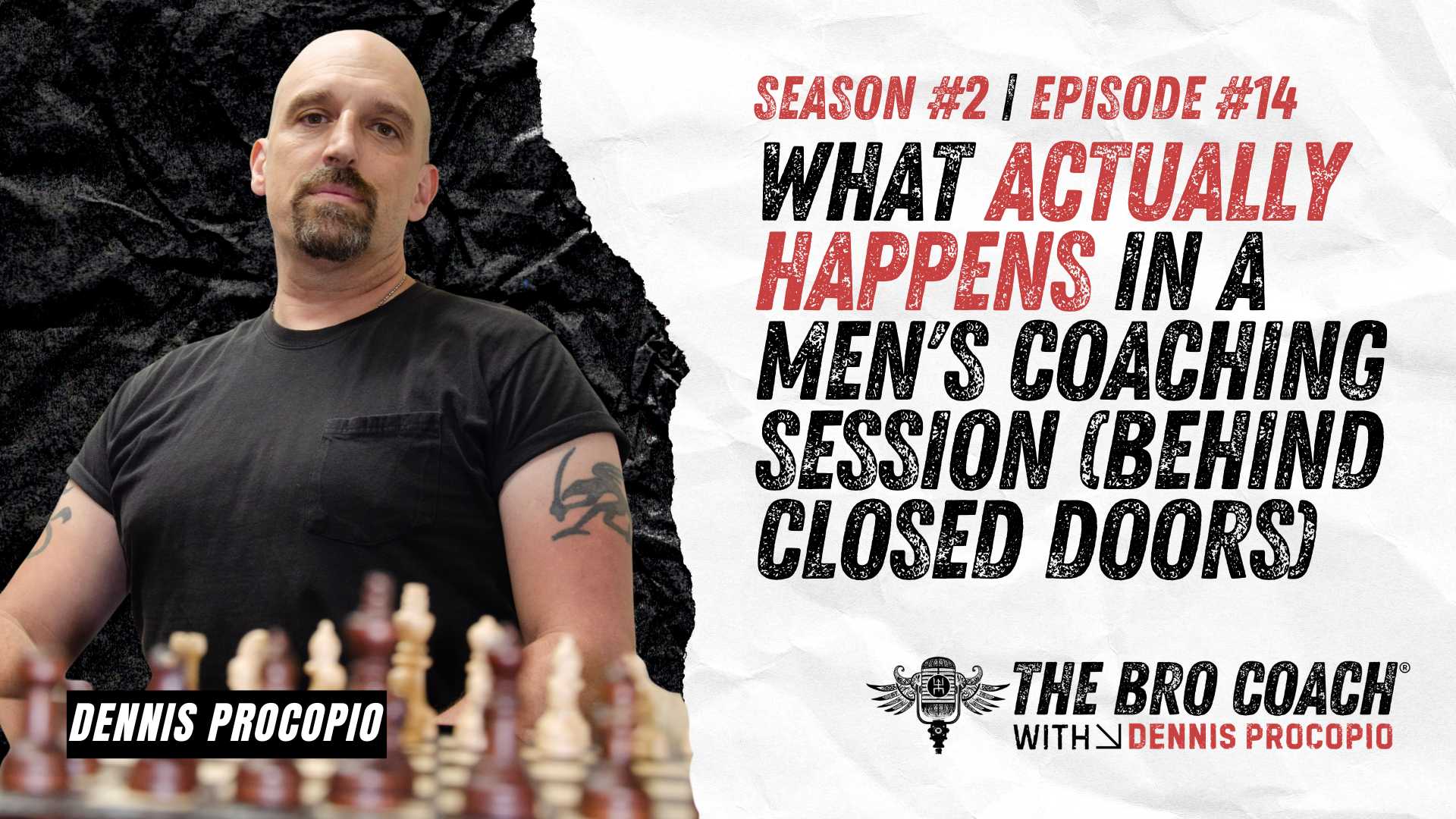
Dennis Procopio: What Actually Happens in a Men's Coaching Session (Behind Closed Doors), Season 2 Episode 14

What Actually Happens in a Men’s Coaching Session (Behind Closed Doors) | S02E14


SUMMARY

Most men who look like they have everything together are carrying pressure no one around them can see. They are successful on paper, dependable at work, and present for their families, yet something underneath the performance is quietly wearing them down. This episode is for high-achieving men who feel trapped by relentless expectations, hidden stress, or the belief that their worth depends on their latest win.

In this rare solo conversation, Dennis Procopio pulls back the curtain on what actually happens in a men’s coaching session. Drawing on nearly fourteen years and more than 25,000 hours coaching men, he explains who walks through his door, what he notices in the first few minutes, and why the client is often not a man who is failing. It is the surgeon, software engineer, executive, or business owner who has achieved the life he was supposed to want and still feels something breaking beneath it.

Dennis describes the physical signs of hidden stress in successful men, including shallow breathing, rigid shoulders, and the white-knuckled need to control every outcome. He explores how high-pressure careers with little margin for failure follow men home, shape their relationships, and turn productivity into a measure of personal value. He also addresses the opposite danger: drifting without meaningful pressure, purpose, or a standard that calls a man forward.

The practical shift is from brutal self-judgment to self-validation. Dennis explains how men can separate self-worth from performance, acknowledge what they are carrying, and develop the presence needed to lead themselves and their families well. He also shows how faith and spirituality can enter the coaching room without dogma, meeting each man where he is.

By the end, you will understand why men choose coaching, what a real session with Dennis feels like, and how honest support can help a successful man stop performing strength and start living it.

Key Topics

  • What actually happens during a private men’s coaching session
  • Physical signs that reveal hidden stress in successful men
  • How high-pressure careers fuel executive burnout at home
  • Why men confuse achievement, productivity, and personal self-worth
  • Replacing brutal self-judgment with practical self-validation
  • How faith and spirituality support coaching without dogma

Resources

Explore the hidden pressure successful men face, why they rarely discuss it, and how honest support builds resilience, clarity, and healthier leadership.

The REAL Pressure Highly Successful Men Carry, But Never Talk About | Season 2, Episode 13


SUMMARY

Highly successful men are often praised for staying composed, solving problems, and carrying responsibility without complaint. What others rarely see is the private pressure underneath the performance: the expectation to provide, lead, protect, decide, and keep winning even when the weight becomes exhausting.

This episode confronts the hidden pressure successful men face and why so many keep it to themselves. Achievement can create freedom, but it can also raise the stakes. More people depend on you, every mistake feels more expensive, and admitting that you are overwhelmed can seem like a threat to the identity you have worked hard to build.

That silence has consequences. Constantly managing stress alone can create isolation, emotional distance, burnout, and conflict at home. A man may look confident and capable from the outside while privately questioning whether he can keep up the pace. When his self-worth becomes tied to performance, slowing down can feel like failure rather than wisdom.

The conversation is for entrepreneurs, executives, providers, leaders, and ambitious men who feel responsible for everyone around them but do not have many places where they can be fully honest. It explores how pressure affects confidence, decision-making, relationships, leadership, and a man’s ability to stay connected to himself.

The practical takeaway is not to abandon ambition. It is to stop confusing silent suffering with strength. Real self-mastery includes recognizing the load, setting honest boundaries, building trusted support, and making room for recovery before pressure turns into resentment or collapse. Successful men do not need less responsibility as much as they need better ways to carry it.

Key Topics

  • Why achievement can increase pressure instead of relieving it
  • How successful men hide stress to protect reputation and relationships
  • The cost of carrying responsibility without honest emotional support
  • Recognizing burnout, isolation, and identity tied to constant performance
  • Practical ways to build resilience, boundaries, and trusted brotherhood
  • Redefining strength through vulnerability, self-awareness, and intentional leadership

Resources

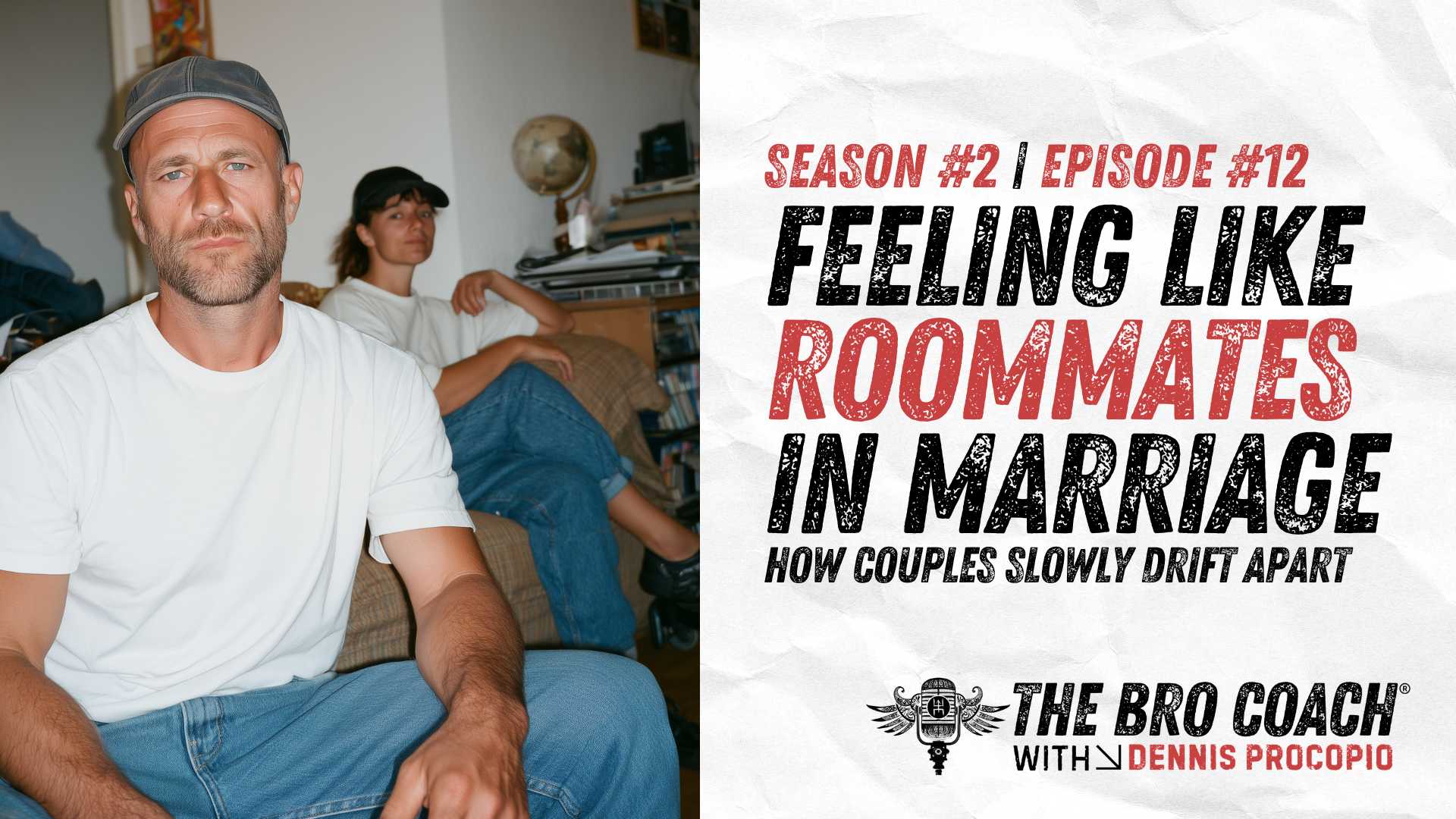
Dennis Procopio, the Bro Coach®, discusses why married couples slowly drift into feeling like roommates, Bro Coach® Podcast Season 2 Episode 12

Feeling Like Roommates in Marriage: How Couples Slowly Drift Apart | Season 2, Episode 12


SUMMARY

Most couples don’t fall apart because of one big blowup. They fall apart because the space between them fills up with logistics: bills, drop-offs, group texts, laundry, work calls. Nobody’s cheating. Nobody’s yelling. You just realize you haven’t had a real conversation in weeks.

You’re not roommates. You’re partners who forgot how to act like it.

Dennis Procopio (The Bro Coach®) breaks down exactly how this happens: the slow, quiet slide from “we” to “us running a household.” It rarely starts with resentment. It starts with convenience: it’s easier to divide tasks than plan a date, easier to scroll next to each other than talk, easier to let “we’re just tired right now” become the default setting for a year.

This episode gets into the real warning signs guys miss: when sex turns into a scheduling problem, when conversation shrinks down to logistics, when you’d rather text your spouse than talk to them, and when “fine” becomes the answer to everything. None of that means the marriage is over. It means it’s on autopilot, and autopilot eventually flies into a mountain.

Dennis lays out what it actually takes to reverse the drift: small, unglamorous, repeatable moves that rebuild connection without requiring a therapy intervention or a second honeymoon. Eye contact. Undivided attention. Actually asking a question and waiting for the answer. The stuff that sounds obvious until you realize you haven’t done it in months.

If your marriage feels more like a business partnership than a relationship, this episode is the reset. Not because your marriage is broken, but because closeness is a discipline, not a default.

Key Topics

  • Why comfortable routines quietly erase romantic and sexual connection
  • The early warning signs your marriage has slipped into roommate mode
  • How avoiding conflict actually speeds up emotional distance between partners
  • Simple daily habits that rebuild intimacy without a big dramatic conversation
  • Why “we’re just tired right now” quietly becomes a permanent excuse

Resources

The Praise Sandwich

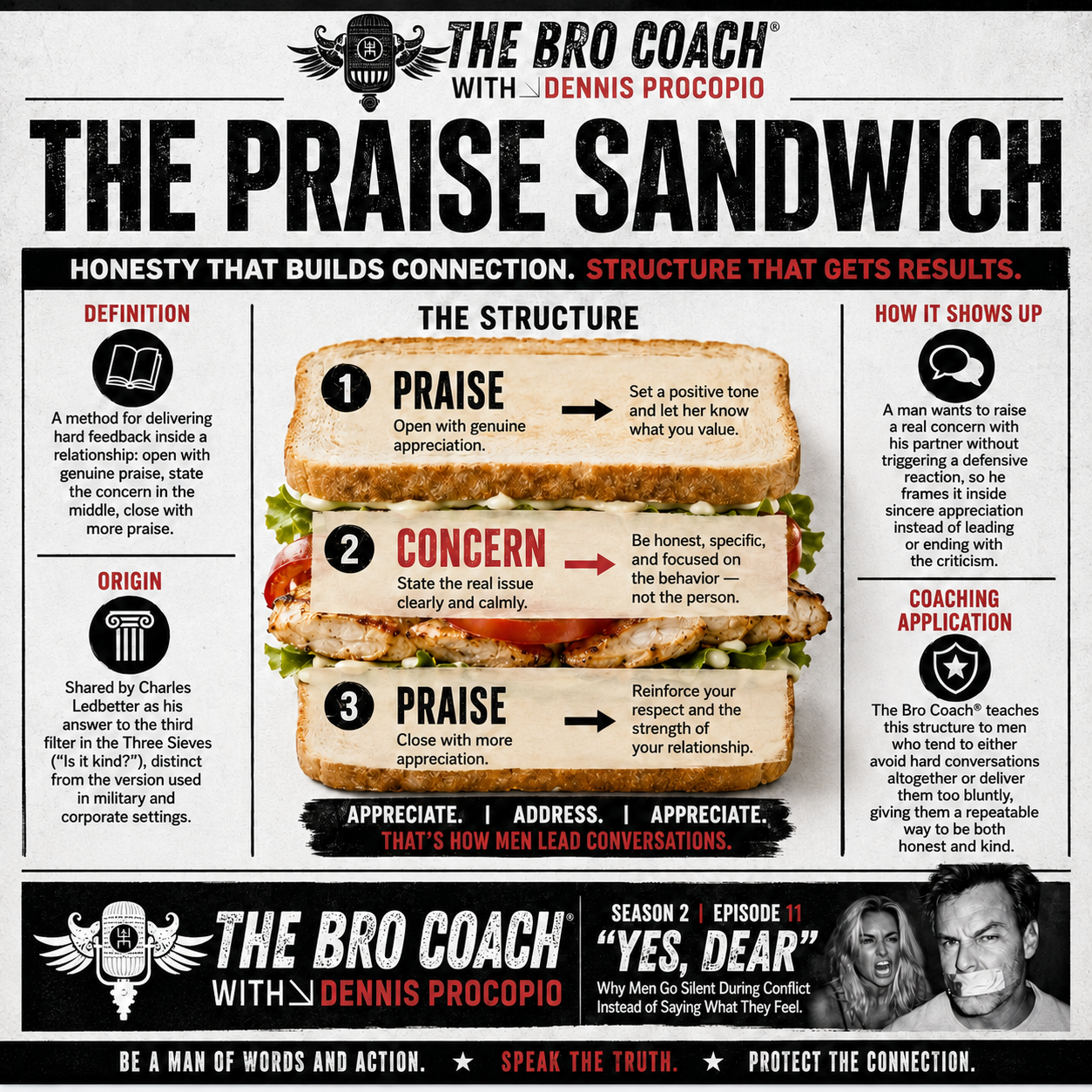
Definition: A method for delivering hard feedback inside a relationship: open with genuine praise, state the concern in the middle, close with more praise.

Origin: Shared by Charles Ledbetter as his answer to the third filter in the Three Sieves (“Is it kind?”), distinct from the version used in military and corporate settings.

How It Shows Up: A man wants to raise a real concern with his partner without triggering a defensive reaction, so he frames it inside sincere appreciation instead of leading or ending with the criticism.

Coaching Application: The Bro Coach® teaches this structure to men who tend to either avoid hard conversations altogether or deliver them too bluntly, giving them a repeatable way to be both honest and kind.

First introduced in The Bro Coach® Podcast, Season 2, Episode 11: “Yes, Dear” | Why Men Go Silent During Conflict Instead of Saying What They Feel.

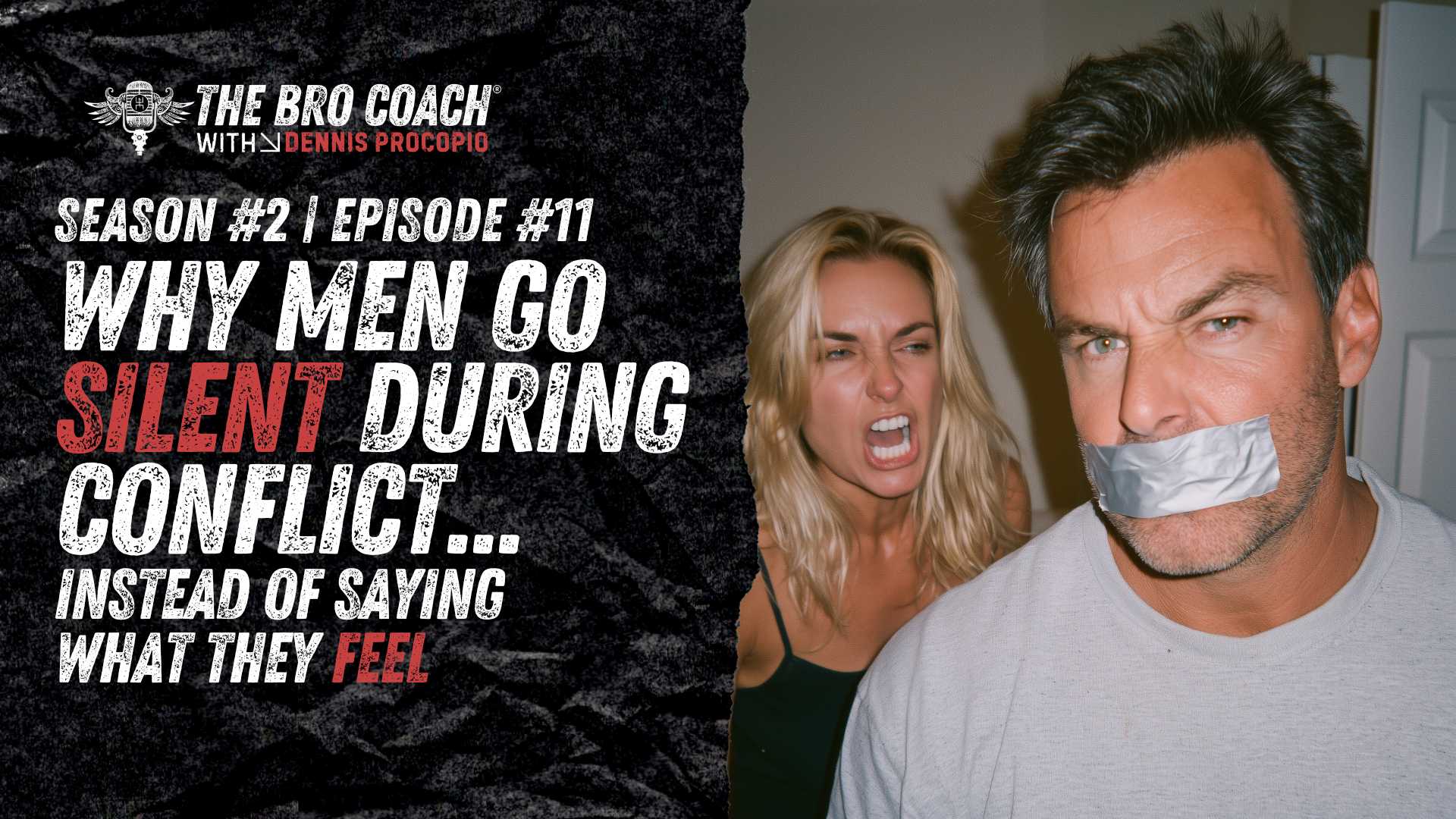
Going silent isn't peace, it's a defense mechanism. Dennis Procopio and Charles Ledbetter on why men stonewall in conflict, and how to actually say what you feel.

“Yes, Dear” | Why Men Go Silent During Conflict Instead of Saying What They Feel | Season 2, Episode 11

Dennis Procopio and Charles Ledbetter on why men stonewall in conflict, and the three-question filter that actually fixes it: true, necessary, kind.

Summary

“Yes, dear. I’m fine. Nothing’s on my mind.” Most men have said some version of this mid-argument, then gone quiet for the rest of the night. It looks like peace. It’s actually a shutdown.

In this episode, Dennis Procopio (The Bro Coach®) and co-host Charles Ledbetter dig into why men stonewall during conflict instead of saying what they actually feel, and why “going silent” so often gets mistaken for calm when it’s really self-protection.

Charles opens up about his own evolution: early on, silence was armor, a way to avoid raging out or saying something he’d regret. Over time he learned that just shutting his mouth wasn’t enough either; his wife needed to feel his emotion, not just his restraint. Dennis breaks down the deeper gap: women in conflict are usually chasing connection and shared experience, while men are wired to solve, stabilize, or wait it out. Neither approach is wrong, but when a man goes quiet without explaining why, his partner reads it as abandonment, not self-regulation, and the disconnect compounds.

The two get into concrete tools for closing that gap: Charles’ “praise sandwich” for delivering hard truths without triggering defensiveness, and Dennis’ filter borrowed from Socrates, the three sieves, is it true, is it necessary, is it kind, for deciding what actually needs to be said out loud. They also role-play a real scenario, showing what it sounds like when a man leads with self-control and honesty instead of silence or a blowup.

This episode is for any man who’s ever said “I’m fine” while clearly not fine, and for the woman trying to figure out why her guy goes quiet instead of just talking to her. It’s not that he’s hiding something deep. It’s that he never learned how to say the thing without it costing him control, respect, or the relationship itself.

Key Topics

  • Why men default to silence instead of saying what they actually feel
  • The real difference between conflict avoidance and healthy self-regulation
  • How men and women process disconnection differently during an argument
  • The “three sieves” filter for deciding what’s worth saying out loud
  • Charles’ praise sandwich technique for delivering hard truths with respect
  • Why going quiet reads as abandonment even when it’s meant as restraint

Resources

Man-UP! In Your Marriage eBook: https://www.manuplifecoaching.com/manning-up-in-marriage

Man UP! Life Coaching Blog: www.manuplifecoaching.com/blog

Schedule a Complimentary 30-Minute Coaching Call: https://www.manuplifecoaching.com/application
The Bro Coach® breaks down how your father's parenting shaped your self-worth. A raw Father's Day coaching session for men ready to do the work.

The Bro Coach® Podcast Drops Father’s Day Special on Fatherhood, Self-Worth, and How Your Dad’s Parenting Is Still Affecting You

FOR IMMEDIATE RELEASE

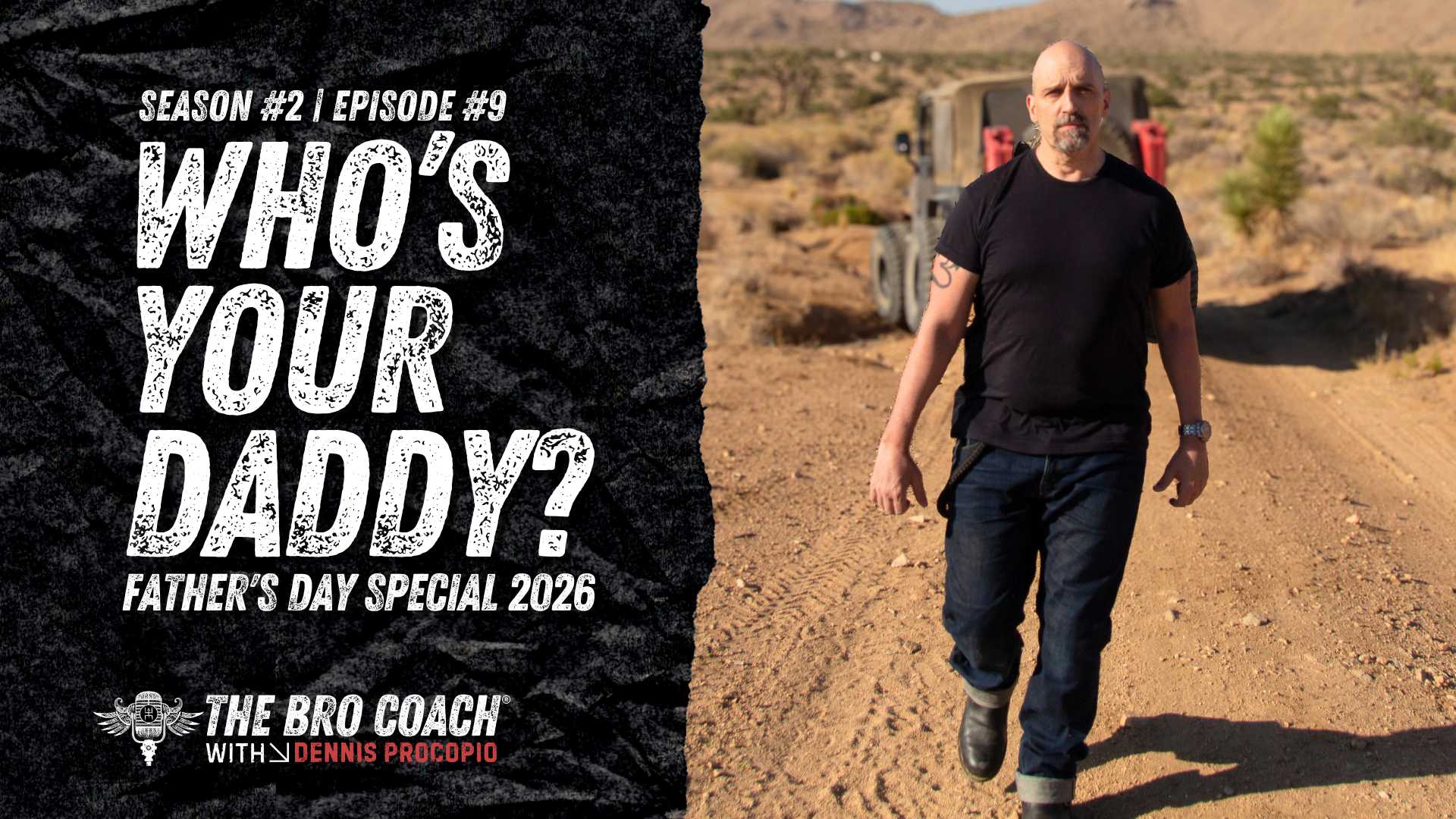
The Bro Coach® Podcast Releases Father’s Day Special: “Who’s Your Daddy?” Tackles Fatherhood, Self-Worth, and the Wounds Men Carry From Their Dads

Man-UP! Life Coaching founder Dennis Procopio delivers a raw solo coaching session on how your father’s parenting style is still shaping your self-worth today

July 1, 2026 — The Bro Coach® Podcast has released its Father’s Day special episode for Season 2: Who’s Your Daddy? Father’s Day Special 2026 (Season 2, Episode 9). Hosted by Dennis Procopio, founder of Man-UP! Life Coaching and creator of the Bro Coach® brand, the episode delivers a direct, unfiltered solo coaching session on one of the least-discussed topics in men’s personal development: how the father you had (or didn’t have) is still running your life as an adult man.

About the Episode

In this Father’s Day solo session, Procopio breaks down two distinct father archetypes and the lasting psychological impact each leaves on sons: the provider dad who gave material advantages but sacrificed his presence, and the absent or abusive father who simply was not equipped to show up. Drawing from more than 25,000 hours of men’s coaching experience and his own personal history, Procopio names the patterns he sees most often in high-performing men, including competency addiction, conditional validation, and the persistent need for a father’s approval that never came.

The episode also speaks directly to the fathers in the audience, challenging them to add a fourth dimension to the traditional male credo of Provide, Protect, and Perform: presence. Procopio outlines three specific practices for fathers (Respect, Empathy, and Presence) and makes the case that a father who is trying is already a good dad.

Key Topics Covered

  • How your father’s parenting style is still shaping your self-worth as an adult man
  • Competency addiction: why high-achieving men need wins to feel worthy
  • The Three P’s (Provide, Protect, Perform) and the presence element most dads miss
  • What fathering your own inner child means and why it matters
  • Three practices every father needs: Respect, Empathy, and Presence

Where to Listen

The episode is available now on all major podcast platforms via Buzzsprout, on YouTube, and on the official episode page at brocoach.com/how-your-father-shapes-self-worth.

About The Bro Coach®

The Bro Coach® Podcast is produced by Man-UP! Life Coaching, a men’s personal development company founded by Dennis Procopio. With more than 25,000 hours of coaching experience, Procopio works with high-performing men on confidence, relationships, leadership, and self-mastery. The podcast is dedicated to the evolved man’s blueprint for strength, presence, and purpose, delivering direct, no-BS coaching conversations for men who are done settling for less than their potential.

Contact

Man-UP! Life Coaching
Website: www.manuplifecoaching.com
Podcast: brocoach.com
Coaching Inquiry: www.manuplifecoaching.com/application
###

The Three P’s

Definition: The Three P’s is the foundational masculine operating system Dennis Procopio (The Bro Coach®) uses to describe the primary drives most men organize their lives around: Provide, Protect, and Perform. These are not inherently problematic. They reflect deep, legitimate masculine instincts. The problem emerges when they become the only way a man measures his value, to the exclusion of presence, emotional availability, and connection.

Provide: The drive to ensure financial security, resources, and stability for yourself and those you are responsible for. The shadow side is a man who works himself to exhaustion in the name of providing while the people he is providing for feel abandoned.

Protect: The drive to keep those you love safe from physical, emotional, and social threats. The shadow side is hypervigilance, control, and the inability to allow vulnerability in yourself or others.

Perform: The drive to execute at a high level, to be competent, capable, and respected. The shadow side is performance anxiety, identity fragility, and the constant need to prove yourself.

Coaching Application: The Bro Coach® teaches men to honor the Three P’s while adding the element most men sacrifice first: presence. A man who provides, protects, and performs at a high level but is emotionally absent is not fully showing up. Integrating all four creates a complete man.

Featured in The Bro Coach® Podcast, Season 2, Episode 9: Who’s Your Daddy? Father’s Day Special 2026.

Conditional Validation

Definition: Conditional validation is approval, affection, or recognition that is given only when specific conditions are met, typically performance, achievement, obedience, or social success. When a child’s primary experience of worth comes from conditional validation, particularly from a parent, he learns that love must be earned and that his intrinsic value is always in question.

Examples: Praise only when grades are exceptional. Approval only when athletic performance meets a standard. Emotional connection only when the child is not inconvenient. A father who says “I love you” only after a win, never in a loss.

Long-Term Impact: Men raised on conditional validation often become high achievers who feel chronically inadequate. They are excellent at performing and terrible at receiving. They struggle to believe positive feedback and overreact to criticism. They seek approval in ways that feel compulsive because they were never given the experience of being enough simply by existing.

The Antidote: The Bro Coach® works with men to build unconditional self-worth: an internal baseline of value that does not rise and fall with performance, status, or other people’s responses. This is not complacency. It is the foundation that allows a man to pursue excellence from a position of strength rather than fear.

Featured in The Bro Coach® Podcast, Season 2, Episode 9: Who’s Your Daddy? Father’s Day Special 2026.

Fathering Your Inner Child

Definition: Fathering your inner child is the practice of consciously providing yourself with the unconditional validation, emotional steadiness, and presence that your father was unable or unwilling to give. Dennis Procopio (The Bro Coach®) uses this framework not as therapy language but as a practical daily discipline for men who are still, at some level, waiting for external approval that may never come.

What It Is Not: This is not about regressing, wallowing in the past, or blaming your father for your current life. It is about recognizing that certain emotional needs were unmet in childhood and that no amount of achievement, money, or external validation will fill that gap. The only person who can do that work is you.

What It Looks Like in Practice: Catching the self-critical voice that sounds like your father and consciously replacing it with unconditional acknowledgment. Allowing yourself to rest without guilt. Celebrating your own wins without immediately moving the goalpost. Practicing the presence and kindness toward yourself that you would give a son you loved.

Coaching Application: The Bro Coach® uses this framework with men who struggle with competency addiction, chronic people-pleasing, emotional avoidance, or the persistent sense that they are not enough. It is one of the foundational practices in men’s coaching because it addresses the source of the wound rather than the symptoms.

Featured in The Bro Coach® Podcast, Season 2, Episode 9: Who’s Your Daddy? Father’s Day Special 2026.

Competency Addiction

Definition: Competency addiction is the psychological pattern where a man’s sense of self-worth is entirely contingent on external achievement, performance, or winning. He does not pursue goals because they are meaningful. He pursues them because not achieving feels like proof of inadequacy. The drive looks like ambition from the outside. The internal experience is closer to survival.

Origin: Usually rooted in conditional validation during childhood, particularly from a father or authority figure who offered praise, approval, or attention only when the man performed at a high level. The brain learns early that worth must be earned and must be constantly re-earned.

How It Shows Up: Inability to rest after achieving. Compulsive comparison to other men’s status or income. Anxiety during unstructured time. A persistent sense of inadequacy regardless of results. Emotional deflation immediately after hitting a goal.

Coaching Application: The Bro Coach® works with men to separate performance from personal worth. The goal is not to stop achieving but to build unconditional self-worth that does not require a leaderboard to exist. True high performance comes from confidence, not from fear of not being enough.

First introduced in The Bro Coach® Podcast, Season 2, Episode 9: Who’s Your Daddy? Father’s Day Special 2026.

Sign In

Register

Reset Password

Please enter your username or email address, you will receive a link to create a new password via email.