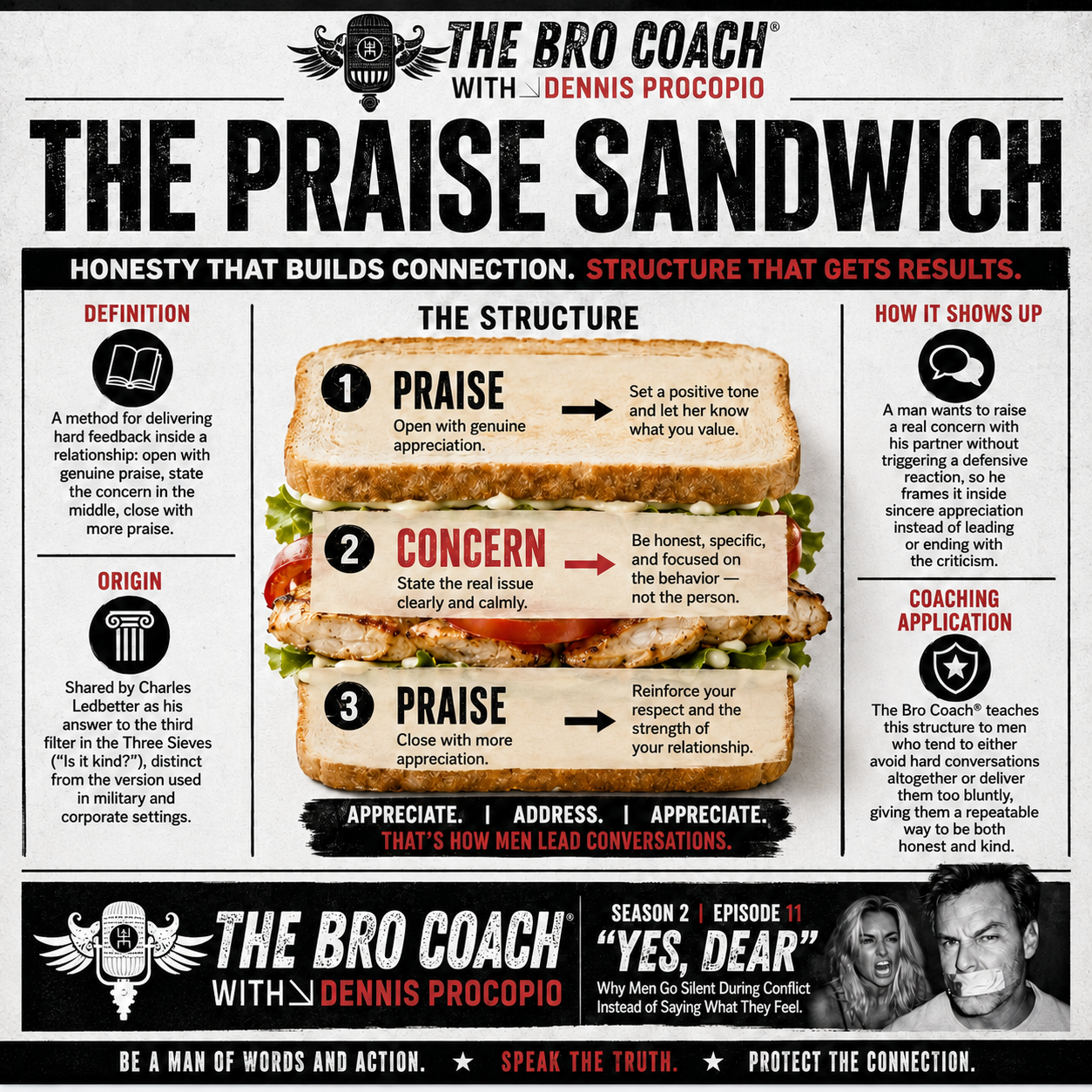
Definition: A method for delivering hard feedback inside a relationship: open with genuine praise, state the concern in the middle, close with more praise.
Origin: Shared by Charles Ledbetter as his answer to the third filter in the Three Sieves (“Is it kind?”), distinct from the version used in military and corporate settings.
How It Shows Up: A man wants to raise a real concern with his partner without triggering a defensive reaction, so he frames it inside sincere appreciation instead of leading or ending with the criticism.
Coaching Application: The Bro Coach® teaches this structure to men who tend to either avoid hard conversations altogether or deliver them too bluntly, giving them a repeatable way to be both honest and kind.
Definition: Conditional validation is approval, affection, or recognition that is given only when specific conditions are met, typically performance, achievement, obedience, or social success. When a child’s primary experience of worth comes from conditional validation, particularly from a parent, he learns that love must be earned and that his intrinsic value is always in question.
Examples: Praise only when grades are exceptional. Approval only when athletic performance meets a standard. Emotional connection only when the child is not inconvenient. A father who says “I love you” only after a win, never in a loss.
Long-Term Impact: Men raised on conditional validation often become high achievers who feel chronically inadequate. They are excellent at performing and terrible at receiving. They struggle to believe positive feedback and overreact to criticism. They seek approval in ways that feel compulsive because they were never given the experience of being enough simply by existing.
The Antidote: The Bro Coach® works with men to build unconditional self-worth: an internal baseline of value that does not rise and fall with performance, status, or other people’s responses. This is not complacency. It is the foundation that allows a man to pursue excellence from a position of strength rather than fear.
Definition: The Three P’s is the foundational masculine operating system Dennis Procopio (The Bro Coach®) uses to describe the primary drives most men organize their lives around: Provide, Protect, and Perform. These are not inherently problematic. They reflect deep, legitimate masculine instincts. The problem emerges when they become the only way a man measures his value, to the exclusion of presence, emotional availability, and connection.
Provide: The drive to ensure financial security, resources, and stability for yourself and those you are responsible for. The shadow side is a man who works himself to exhaustion in the name of providing while the people he is providing for feel abandoned.
Protect: The drive to keep those you love safe from physical, emotional, and social threats. The shadow side is hypervigilance, control, and the inability to allow vulnerability in yourself or others.
Perform: The drive to execute at a high level, to be competent, capable, and respected. The shadow side is performance anxiety, identity fragility, and the constant need to prove yourself.
Coaching Application: The Bro Coach® teaches men to honor the Three P’s while adding the element most men sacrifice first: presence. A man who provides, protects, and performs at a high level but is emotionally absent is not fully showing up. Integrating all four creates a complete man.
Definition: Fathering your inner child is the practice of consciously providing yourself with the unconditional validation, emotional steadiness, and presence that your father was unable or unwilling to give. Dennis Procopio (The Bro Coach®) uses this framework not as therapy language but as a practical daily discipline for men who are still, at some level, waiting for external approval that may never come.
What It Is Not: This is not about regressing, wallowing in the past, or blaming your father for your current life. It is about recognizing that certain emotional needs were unmet in childhood and that no amount of achievement, money, or external validation will fill that gap. The only person who can do that work is you.
What It Looks Like in Practice: Catching the self-critical voice that sounds like your father and consciously replacing it with unconditional acknowledgment. Allowing yourself to rest without guilt. Celebrating your own wins without immediately moving the goalpost. Practicing the presence and kindness toward yourself that you would give a son you loved.
Coaching Application: The Bro Coach® uses this framework with men who struggle with competency addiction, chronic people-pleasing, emotional avoidance, or the persistent sense that they are not enough. It is one of the foundational practices in men’s coaching because it addresses the source of the wound rather than the symptoms.
Definition: Competency addiction is the psychological pattern where a man’s sense of self-worth is entirely contingent on external achievement, performance, or winning. He does not pursue goals because they are meaningful. He pursues them because not achieving feels like proof of inadequacy. The drive looks like ambition from the outside. The internal experience is closer to survival.
Origin: Usually rooted in conditional validation during childhood, particularly from a father or authority figure who offered praise, approval, or attention only when the man performed at a high level. The brain learns early that worth must be earned and must be constantly re-earned.
How It Shows Up: Inability to rest after achieving. Compulsive comparison to other men’s status or income. Anxiety during unstructured time. A persistent sense of inadequacy regardless of results. Emotional deflation immediately after hitting a goal.
Coaching Application: The Bro Coach® works with men to separate performance from personal worth. The goal is not to stop achieving but to build unconditional self-worth that does not require a leaderboard to exist. True high performance comes from confidence, not from fear of not being enough.
Definition: The Provider Dad is a father archetype Dennis Procopio (The Bro Coach®) uses to describe the man who gives his family every material advantage, financial security, a good home, education, opportunity, while remaining emotionally or physically absent from their daily lives. He is not a bad man. He is often an exceptional man by most conventional measures. But his version of fatherhood is expressed almost entirely through provision rather than presence.
The Invisible Cost: The Provider Dad’s sons often grow up in a paradox. They are grateful for everything their father built and quietly grieving the version of him they never got. They internalize the message, usually unconsciously, that love is expressed through sacrifice rather than presence. Many of them go on to replicate the same pattern in their own families.
The Treadmill: The Provider Dad is not absent because he does not care. He is absent because he is on a treadmill of responsibility that never stops. He is simultaneously piloting a plane and expected to enjoy being a passenger. The pressure to provide creates the very absence that his family experiences as abandonment.
Coaching Application: Men who grew up with a Provider Dad often need to untangle gratitude from longing, and provision from love. They also often need to recognize where they are replicating the pattern with their own families. The Bro Coach® helps these men integrate the drive to provide with the capacity to be present, so the next generation does not inherit the same wound.